Lead Generation
Singapore B2B Telemarketing Benchmark Report
Estimated Reading Time : 10–12 minutes
Data-Backed Insights from 20,000+ Business-to-Business Cold Calls
Singapore’s B2B market is uniquely fast-paced, dense, and compliance-conscious. To provide revenue leaders, SDR managers and business owners with actionable clarity, our team analyzed performance metrics across 20,000+ B2B telemarketing calls conducted in Singapore.
This benchmark report breaks down conversion rates by industry, optimal timing windows, meeting attendance metrics, lead decay curves and the most common objection drivers in local outbound campaigns.
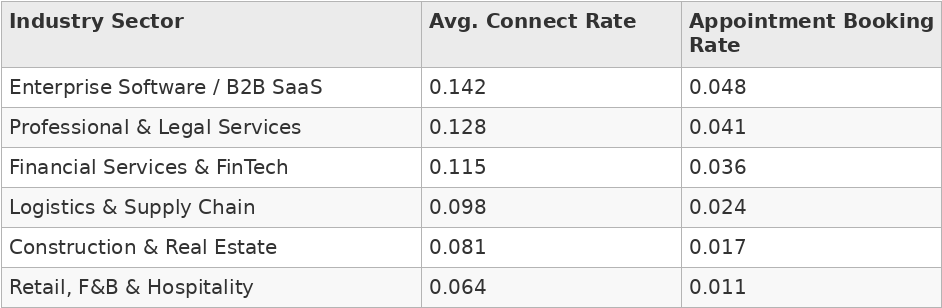
1. Industry Appointment Rates: Where Outreach Yields the Highest ROI
Not all sectors in Singapore respond to phone-based outreach equally. High-margin, process-driven or tech-forward industries exhibit significantly higher conversion rates, whereas labor-intensive or operationally fragmented sectors present steeper resistance.
Key Takeaway
B2B SaaS and Professional Services yield the highest return on call effort. When targeting desk-bound executives in Singapore’s Central Business District (CBD), direct mobile dial availability drastically elevates appointment rates compared to switchboard extensions.
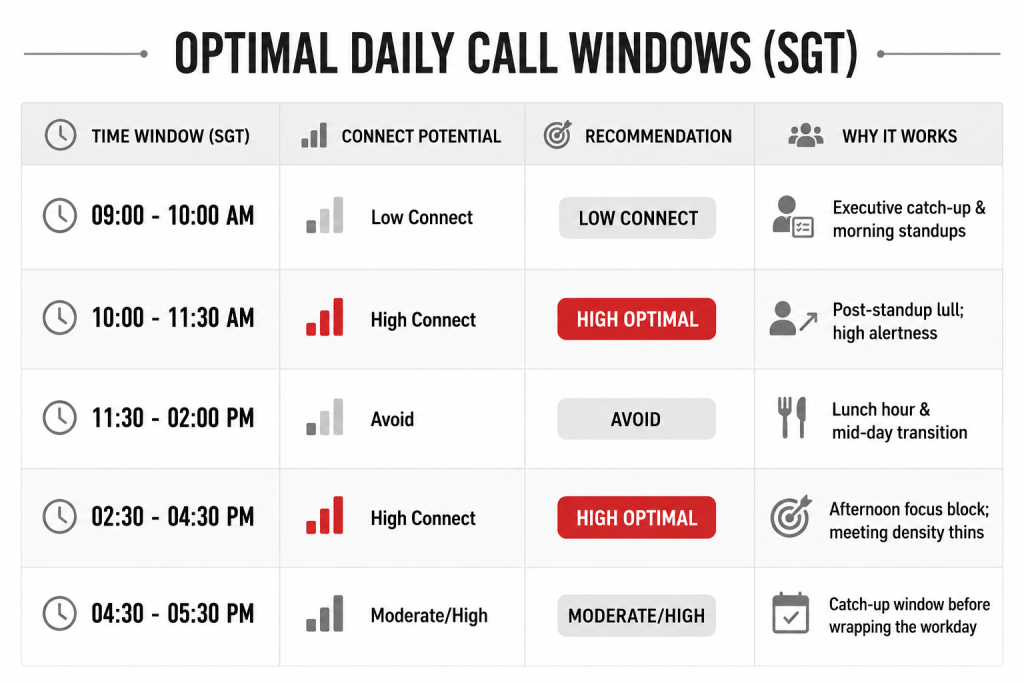
2. Timing the Call: Best Days & Windows for Singapore Prospects
Reaching Singapore C-suite executives and division heads requires navigating meeting-heavy corporate calendars and localized workplace rhythms.
Conversion Rate by Day of the Week
Tuesday – Thursday (Peak Window): Accounts for 71% of total booked appointments. Tuesday morning yields the highest raw connect rate, while Wednesday afternoon generates the highest call-to-meeting conversion rate.
Monday (Preparation Day): Yields moderate connect rates but a 31% lower meeting conversion rate than Wednesday. Executives prioritize internal standups, weekly planning and clearing weekend email backlogs.
Friday (Wrap-Up Day): Connect rates decline rapidly after 2:00 PM as decision-makers pivot to weekend transition tasks or early departures.
3. Meeting Show-Up Rates: The Gap Between Booking and Attending
Booking an appointment is only half the battle. In Singapore’s fast-moving business culture, calendar friction and sudden meeting conflicts result in notable drop-off rates if left unmanaged.
Average B2B Show-Up Rate: 64.2% across all industry sectors.
Qualified Demo Show-Up Rate: 73.8% when pre-qualification criteria are enforced during the call.
Unqualified / Soft Booking Show-Up Rate: 41.5% when sales reps accept weak verbal agreement without calendar confirmation.
Strategic Interventions to Maximize Attendance
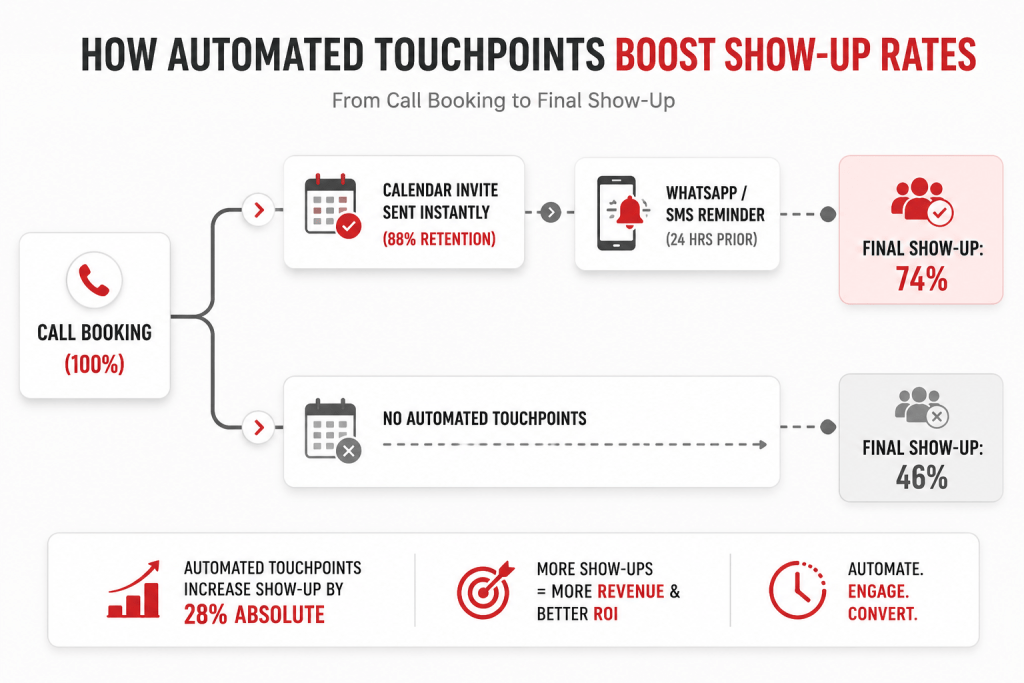
Instant Calendar Invitations: Sending a Google or Outlook calendar invite within 5 minutes of ending the call increases attendance by 18%.
Local Multi-Channel Reminders: In Singapore, sending a concise WhatsApp reminder 24 hours prior including a 1 sentence agenda, reduces no-shows by 27%.
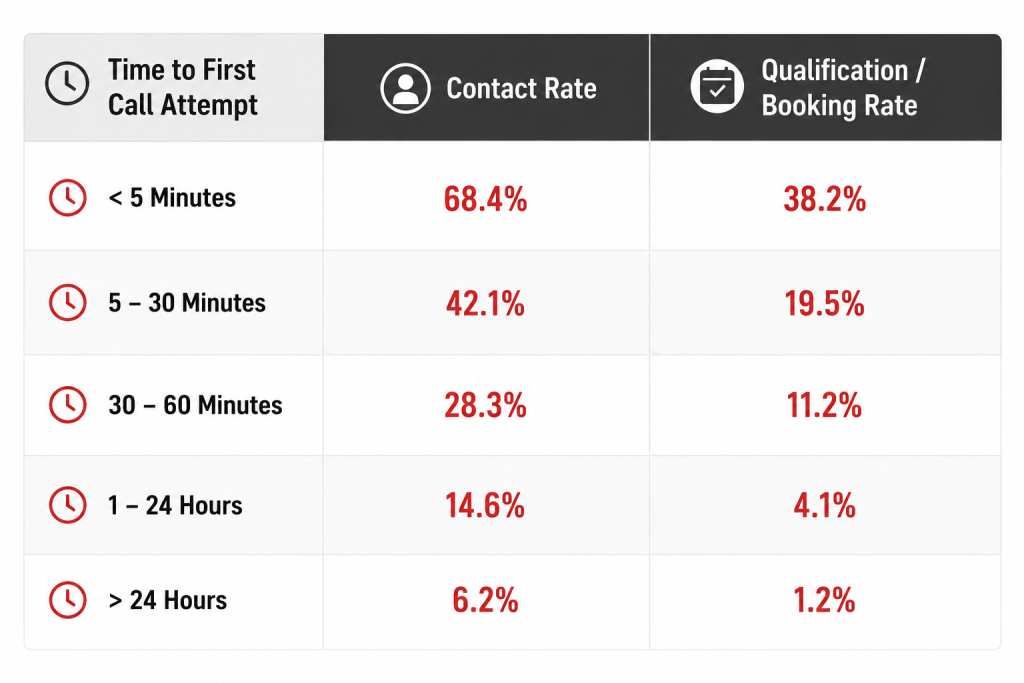
4. Speed-to-Lead: Response Time vs. Decay Curve
For inbound leads generated via marketing campaigns, whitepaper downloads or contact forms, response latency is the single greatest factor in call-to-meeting conversions.
Inbound prospects contacted within 5 minutes are over 9 times more likely to convert into a scheduled demo than those contacted after an hour. Beyond 24 hours, the lead effectively goes cold.
5. Voice of the Prospect: Why Singapore Prospects Reject Calls
Analyzing explicit feedback and call wrap-up codes reveals five primary rejection drivers:
“Send me an email first” (34%): The default soft brush-off in Singapore corporate culture. Solution: Reps who pivot by asking a specific qualifying question (“Happy to send over relevant data—are you currently focused on X or Y?”) recover 19% of these conversations.
“We already have an existing vendor/solution” (22%): Common in mature markets. Solution: Shift focus from replacement to benchmarking (“We don’t expect you to switch today; most clients keep their primary vendor while using us to bridge gap Z”).
“In meetings all day / Bad timing” (18%): Solution: Secure a specific callback timestamp immediately rather than offering a generic follow-up.
“No budget / Not a priority right now” (14%): Often indicates a value perception gap rather than a zero-dollar constraint.
PDPA and Data Privacy Concerns (9%): Singapore decision-makers are cautious regarding Personal Data Protection Act (PDPA) compliance and unknown numbers. Transparently stating how their corporate contact info was sourced resolves compliance friction quickly.
Strategic Summary for Revenue Leaders
To optimize B2B cold calling campaigns in Singapore based on these 20,000 data points:
Focus Core Dialing Blocks: Concentrate heavy cold calling volumes between 10:00–11:30 AM and 02:30–04:30 PM, Tuesday through Thursday.
Enforce Speed-to-Lead SLA: Mandate an automated dialer or SDR routing rule to touch all inbound form fills within 5 minutes.
Systematize Attendance Workflows: Integrate automated calendar invites and 24-hour WhatsApp reminders to elevate show-up rates above 70%.
Train for Soft Rejections: Equip calling teams with value-add questions when prospects default to the “Send me an email” objection.
Don't let cold calls go warm.
Partner with a Singapore-focused B2B telesales team that turns data into qualified meetings.