Best Lead Generation Companies in Singapore: 2026 Guide
September 9, 2026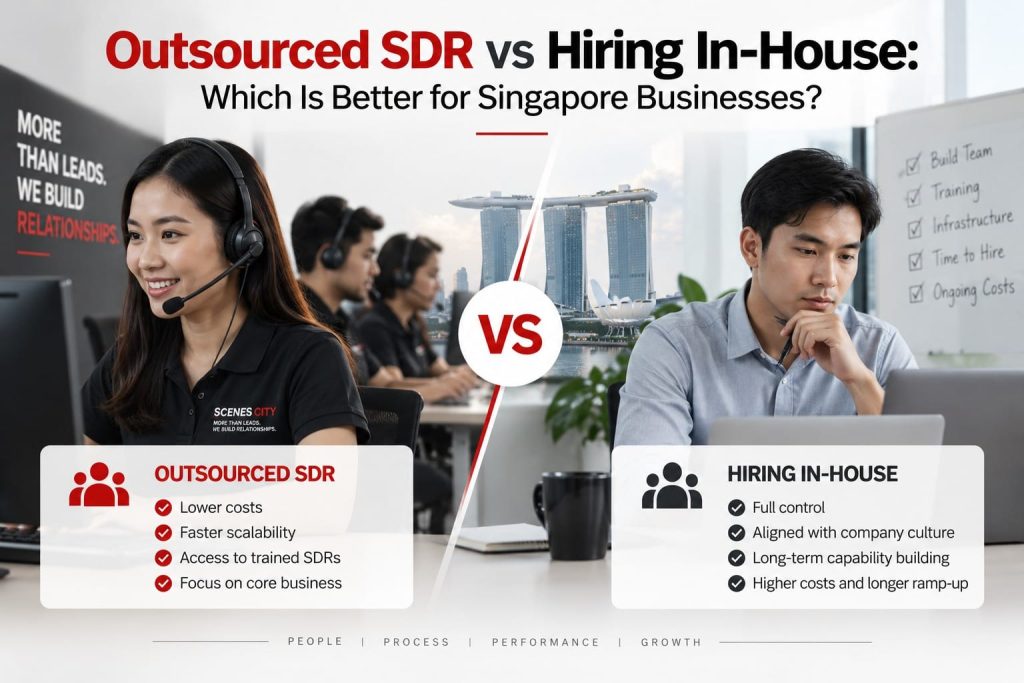
Outsourced SDR vs Hiring In-House: Which Is Better for Singapore Businesses?
Building a predictable B2B sales pipeline requires more than having a good product.
Businesses need people who can identify potential customers, research decision-makers, make initial contact, qualify prospects and create sales opportunities for the sales team.
This is where a Sales Development Representative (SDR) comes in.
Traditionally, businesses hired SDRs internally. However, outsourcing sales development has become an alternative for companies that want to build a sales pipeline without hiring and managing an entire outbound sales team.
So which is better: outsourcing your SDR function or hiring SDRs in-house?
The answer depends on your budget, sales objectives, target market, internal resources and how quickly you need to build your pipeline.
What Does an SDR Actually Do?
A Sales Development Representative is typically responsible for the early stages of the B2B sales process.
Unlike an Account Executive, whose role is generally focused on closing opportunities, an SDR concentrates on creating those opportunities. Typical SDR activities include:
- Identifying potential customers
- Building prospect lists
- Researching companies and decision-makers
- Cold calling
- Email outreach
- LinkedIn prospecting
- Lead qualification
- Following up with prospects
- Scheduling sales appointments
- Updating CRM records
- Passing qualified opportunities to sales executives
The basic process looks like this:
Prospecting → Outreach → Qualification → Appointment → Sales Handoff
For companies with a complex B2B sales process, having a dedicated SDR function can help sales executives spend more time on qualified opportunities rather than prospecting.
What Is an Outsourced SDR?
An outsourced SDR is a sales development professional provided by an external company.
Instead of hiring, training and managing your own SDR team, you work with an outsourced sales development provider that handles some or all of the prospecting process. Depending on the provider, this can include:
- Prospect research
- Database development
- Cold calling
- Email outreach
- LinkedIn outreach
- Lead qualification
- Appointment setting
- CRM management
- Reporting
- Campaign optimisation
Some providers operate on a dedicated-team model, while others use shared teams or campaign-based arrangements.
The important point is that outsourcing doesn’t necessarily mean giving up control of your sales process. A good outsourced SDR programme should operate according to your ICP, messaging, qualification criteria and sales objectives.
Outsourced SDR vs In-House SDR
The biggest difference is where the sales development capability sits.
| Factor | Outsourced SDR | In-House SDR |
|---|---|---|
| Hiring | Provider handles recruitment | Your company recruits |
| Training | Usually handled by provider | Internal responsibility |
| Management | Provider manages team | Your sales manager manages team |
| Technology | Often included | Company provides |
| Prospecting | Provider | Internal team |
| Lead qualification | Provider | Internal team |
| Appointment setting | Usually available | Internal team |
| Scaling | Generally faster | Requires additional hiring |
| Fixed employee cost | Lower | Higher |
| Company control | Shared | Higher |
| Product knowledge | Requires onboarding | Usually deeper over time |
| Infrastructure | Provider's | Company's |
| Recruitment risk | Lower | Higher |
Neither model is automatically better. The question is which model makes more economic and operational sense for your business.
The Cost of Hiring an In-House SDR
Salary is only one part of the cost of building an internal SDR function. Businesses should also consider:
- Recruitment costs
- Employer contributions
- Employee benefits
- Bonuses and commissions
- Sales management
- CRM software
- Prospecting databases
- Calling systems
- Email tools
- LinkedIn tools
- Training
- Onboarding
- Office and equipment costs
- Employee turnover
- Management time
For example, if a company hires two SDRs, the real cost is not simply 2 × SDR salary.
The business is also building an entire sales development infrastructure around those employees. This can make an in-house SDR team expensive during the early stages of a company’s outbound sales programme.
The Hidden Cost of SDR Recruitment
One of the biggest challenges isn’t actually salary.
It’s finding the right people. An SDR needs to be comfortable with:
- Cold outreach
- Rejection
- Repetitive prospecting
- Phone conversations
- Research
- CRM administration
- Follow-up
- Performance targets
Not every salesperson is suited to an SDR role. There is also the issue of turnover. If an SDR leaves after several months, the company may have to repeat:
Recruit → Interview → Hire → Train → Ramp Up
This can interrupt pipeline generation. An outsourced provider can potentially reduce some of this operational burden because recruitment, staffing and team management sit with the provider.
Advantages of Hiring SDRs In-House
There are several good reasons to build an internal SDR team.
Greater Control
Your management team has direct control over:
- Messaging
- Daily activity
- Prospect selection
- Training
- Performance
- CRM processes
Deeper Product Knowledge
An internal SDR works directly inside your organisation and can develop deeper understanding of:
- Your product
- Your customers
- Your competitors
- Your sales process
- Your company culture
Easier Collaboration
An internal SDR can work closely with marketing, sales, product, customer success and management — making it easier to continuously refine the sales process.
Disadvantages of Hiring SDRs In-House
The downside is that you take responsibility for the entire operation. You need to:
- Recruit SDRs
- Train them
- Provide technology
- Build prospect lists
- Develop scripts
- Manage performance
- Monitor calls
- Manage CRM activity
- Replace employees who leave
- Develop the sales process
For an established sales organisation, this may be completely reasonable. For an SME testing outbound sales for the first time, it can be a significant commitment.
Advantages of Outsourcing SDR
01
Faster Deployment
An established provider may already have SDRs, telemarketing infrastructure, CRM systems, prospecting tools, calling systems, scripts and reporting systems — allowing a company to launch an outbound campaign faster than building the operation internally.
02
Lower Operational Burden
Instead of managing individual SDRs, your management team can focus on strategy, sales, product and customer relationships while the outsourced provider manages the day-to-day prospecting operation.
03
Access to Specialised Expertise
An experienced SDR provider may have already run campaigns across different industries and customer segments — providing access to expertise in prospecting, cold calling, qualification, appointment setting, objection handling and campaign optimisation.
04
Easier Scalability
Suppose you initially want to test a campaign with one SDR. If the campaign works, you may want to increase capacity — with an outsourced model, scaling can potentially be simpler than recruiting several additional employees.
Disadvantages of Outsourcing SDR
Outsourcing isn’t perfect either.
01
Less Direct Control
You don’t have the same level of day-to-day control as you would with employees sitting inside your organisation. That’s why communication, reporting and agreed KPIs are important.
02
Onboarding Is Critical
An outsourced SDR needs to understand your product, ideal customer profile, value proposition, competitors, qualification criteria, objections and sales process. A poor onboarding process can result in poor-quality conversations.
Brand Representation Matters
Your SDR is representing your company when contacting prospects. The provider therefore needs appropriate scripts, training, quality control, call monitoring and brand guidelines. The cheapest outsourced SDR provider isn’t necessarily the best option.
When Should You Hire SDRs In-House?
An internal team may make more sense when:
You have a proven outbound sales model
You already know who your ICP is, which messaging works, which channels work, what your conversion rates are, and how many SDRs you need. At this point, bringing the function in-house can give you greater control.
You need deep product expertise
If your product requires extensive technical knowledge, an internal SDR may have an advantage.
You want to build a long-term sales organisation
If sales development is a core strategic capability, investing internally may make sense.
When Should You Outsource SDR?
You're testing outbound sales
You don't have an SDR manager
You need appointments quickly
You want to enter a new market
Your salespeople are spending too much time prospecting
Outsourced SDR vs In-House: A Simple Decision Framework
Ask yourself five questions.
Do we already have a proven outbound sales process?
Do we have someone who can manage SDRs?
How quickly do we need to launch?
How specialised is our product?
Are we trying to build a sales department or generate sales opportunities?
This may be the most important question.
If the goal is “Build a permanent sales development organisation” — an in-house team may be the right long-term choice.
If the goal is “Generate qualified sales opportunities” — outsourcing may be the more efficient starting point.
A Hybrid Model Can Also Work
Businesses don’t necessarily have to choose one model. A hybrid approach can combine:
Outsourced SDR → Internal Account Executive
The outsourced team handles:
- Prospecting
- Initial outreach
- Lead qualification
- Appointment setting
Your internal sales team handles:
- Discovery
- Proposal
- Negotiation
- Closing
This can create a clear division of responsibilities. The outsourced SDR team fills the top of the funnel while your internal salespeople focus on revenue-generating activities further down the funnel.
What Should You Measure?
Whether your SDRs are internal or outsourced, don’t measure success purely by the number of calls made. A better funnel is:
↓
↓
The further down the funnel you measure, the more useful your analysis becomes.
For example, an SDR team that makes 5,000 calls but generates only 10 qualified opportunities may be less effective than a team making 2,000 calls and generating 30 qualified opportunities.
What Should You Ask an Outsourced SDR Provider?
Before signing an agreement, ask:
How do you build the prospect database?
Understand where the data comes from and how it is maintained.
How do you define a qualified lead?
Get the qualification criteria in writing.
Who makes the calls?
Ask about the team’s experience, location and training.
Do you provide appointment setting?
If your objective is meetings, make sure appointment setting is explicitly included.
How do you monitor call quality?
Ask whether calls are recorded, reviewed and coached.
How do you report performance?
You should receive meaningful metrics rather than simply activity numbers.
How do you handle our CRM?
Clarify whether the provider works inside your CRM or its own platform.
How quickly can you launch?
Understand the onboarding process and expected ramp-up period.
Thinking About Outsourcing Your SDR Function?
See how Scenes City’s outsourced SDR team can help you test, validate or scale your outbound sales pipeline.
So, Which Is Better?
There is no universal answer.
Hire In-House If You...
- Have a proven outbound sales process
- Need maximum control
- Require deep product expertise
- Have sales management resources
- Want to build a permanent SDR organisation
Consider Outsourcing If You...
- Want to test outbound sales
- Need to launch quickly
- Don't have SDR management expertise
- Want to reduce recruitment and infrastructure requirements
- Need qualified appointments for your sales team
- Are entering a new market
For many SMEs, outsourcing can be a practical way to test and establish an outbound sales channel before making a larger investment in an internal team.
For established sales organisations, building an internal SDR function may provide greater control and deeper integration with the rest of the sales organisation.
Ultimately, the right question isn’t:
“Should we outsource or hire?”
It’s: “What is the most efficient way for us to consistently create qualified sales opportunities?”
If an outsourced SDR partner can generate those opportunities at an attractive cost while maintaining lead quality and brand standards, outsourcing may make sense.
If outbound sales is already a proven and strategically important part of your business, investing in an internal SDR team may provide greater long-term control.
The best model is the one that produces a predictable, measurable and commercially viable sales pipeline.
Still Deciding Between In-House and Outsourced?
Talk to our team about your sales objectives, timeline and budget — we’ll help you think through which model fits your business right now.